
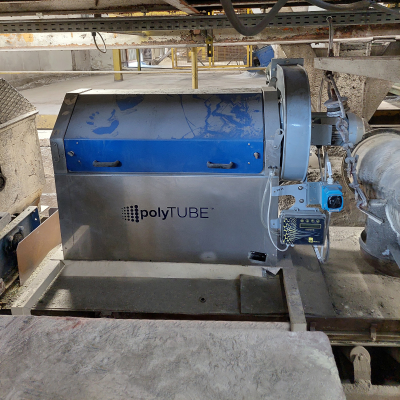
WAMGROUP has highlighted its WAMAIR Spot polyTUBE filtration system, which combines compact tubular filter elements with an electrically driven mechanical cleaning mechanism to reduce energy consumption, installation requirements and maintenance associated with conventional compressed-air cleaning systems.
Designed for bulk solids handling and processing equipment, the spot filter captures airborne dust close to its source, helping limit material loss and reduce reliance on extensive centralised extraction systems. The separated material is returned directly to the process, supporting efficient material handling and dust control.
Unlike conventional filtration systems that rely on compressed air for cleaning, WAMAIR Spot polyTUBE uses mechanical cleaning technology. This eliminates the need for compressed-air supply lines and associated components, potentially reducing energy requirements and maintenance. The design also addresses operational challenges associated with moisture, condensation and low temperatures in compressed-air systems.
The system features polyTUBE filter elements with an open-profile tubular cell structure designed to provide a large effective filtration surface within a compact volume. According to WAMGROUP's technical information, the polyTUBE technology offers approximately four times the performance of conventional filter elements. The filter geometry and media are also designed to limit residual dust retention, supporting effective cleaning and stable filtration performance.
The filter elements are installed vertically inside a stainless-steel casing. Their compact dimensions are intended to facilitate installation in space-constrained locations, including conveyors, transfer points and other bulk material processing applications where available headroom is limited.
By integrating local dust capture with compressed-air-free cleaning, WAMGROUP's WAMAIR Spot polyTUBE system aims to simplify plant integration while reducing the infrastructure and maintenance requirements of industrial dust filtration. The technology may be particularly relevant for facilities seeking to improve dust management and operational efficiency without installing extensive ductwork or additional pneumatic infrastructure.


